Can a Lender Be Excluded from the Committee of Creditors? Supreme Court Clarifies Related-Party Status Under the IBC
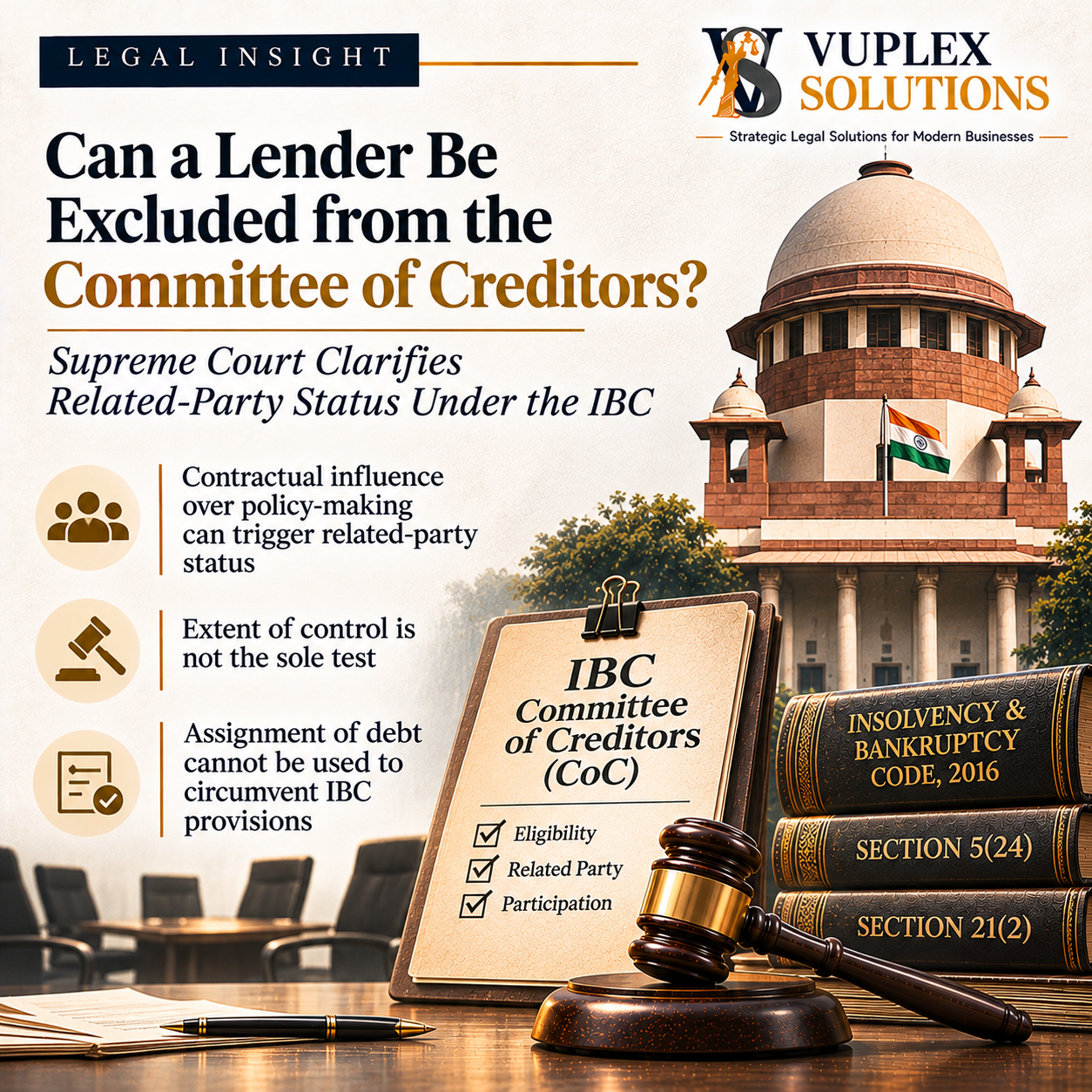
A lender does not necessarily have to control the day-to-day management of a company to be treated as its related party under the Insolvency and Bankruptcy Code, 2016. In a significant judgment, the Supreme Court has clarified that contractual rights enabling a financial creditor to participate in the corporate debtor's policy-making processes may be sufficient to disqualify it from participating in the Committee of Creditors.
The Committee of Creditors (CoC) plays a central role in the corporate insolvency resolution process. It evaluates resolution plans, considers proposals concerning the corporate debtor and exercises decision-making powers under the Insolvency and Bankruptcy Code, 2016 (IBC).
The composition of the CoC is therefore not merely a procedural question. It determines which financial creditors can participate in the resolution process and exercise voting rights over decisions affecting the future of the corporate debtor.
A recent decision of the Supreme Court in ECL Finance Ltd. and Anr. v. Abhinav Mukherjee and Ors., 2026 INSC 1159, decided on October 27, 2026, addresses an important aspect of this framework: whether a lender exercising extensive contractual influence over a corporate debtor can be classified as a related party and consequently excluded from the CoC.
The judgment provides important guidance on the interpretation of Section 5(24)(m)(i) read with the first proviso to Section 21(2) of the IBC.
Background of the dispute
The dispute arose from financing arrangements involving Saha Infratech Private Limited (SIPL) and Palm Developers Private Limited, with Palm Developers acting as the corporate guarantor.
ECL Finance Limited (ECL) had subscribed to non-convertible debentures issued by SIPL. The first tranche of debentures amounted to ₹110 crore. ECL had also extended a separate revolving credit facility of ₹90 crore to SIPL.
IDBI Trusteeship Services Limited (ITSL) acted as the debenture trustee.
Palm Developers had furnished corporate guarantees and provided security in connection with these financing arrangements.
Following the commencement of the Corporate Insolvency Resolution Process (CIRP) against Palm Developers on January 27, 2020, ITSL submitted a claim of approximately ₹131.17 crore in its capacity as debenture trustee. ECL separately submitted a claim of approximately ₹139.02 crore under the facility agreement.
Both entities were initially included in the Committee of Creditors as financial creditors.
However, a homebuyer challenged their inclusion, contending that ECL and ITSL were related parties of the corporate debtor and were therefore ineligible to participate in the CoC.
The National Company Law Tribunal (NCLT) accepted the objection, and the National Company Law Appellate Tribunal (NCLAT) subsequently upheld the exclusion.
Aggrieved by these findings, ECL and ITSL approached the Supreme Court.
The central legal question: What constitutes participation in policy-making?
Section 5(24) of the IBC defines the expression “related party” in relation to a corporate debtor.
Under Section 5(24)(m)(i), a person may be regarded as a related party if the person is associated with the corporate debtor on account of participation in its policy-making processes.
The first proviso to Section 21(2) provides that a financial creditor who is a related party of the corporate debtor shall not have the right of representation, participation or voting in a meeting of the Committee of Creditors, subject to the statutory framework.
The principal issue was whether the contractual rights available to ECL amounted to participation in the policy-making processes of Palm Developers.
The appellants essentially disputed the finding that their contractual arrangements created the degree of influence necessary to attract the related-party provisions.
Supreme Court distinguishes policy-making influence from the test of control
The Supreme Court examined the distinction between the related-party test under Section 5(24) and the concept of control considered under Section 29A of the IBC.
In ArcelorMittal India Private Limited v. Satish Kumar Gupta, (2019) 2 SCC 1, the Supreme Court had examined the concept of positive control in the context of eligibility to submit a resolution plan under Section 29A.
The Court clarified that the test under Section 5(24)(m)(i) is not identical to the stricter requirement of positive control applicable under Section 29A(c) and (g).
For determining participation in policy-making under Section 5(24)(m)(i), it is not necessary to establish that the lender is in complete control of the corporate debtor or is directing its everyday business operations.
“The requirement would not be to the extent of being in the driving seat, but a role of navigation would suffice, in determining policy and channelising business interests.”
This distinction is important.
A lender may not formally manage a company or independently make all its business decisions. However, where its contractual rights allow it to influence important policy decisions, the statutory test of participation in policy-making may still be satisfied.
The assessment must therefore focus on the actual rights created under the financing documents and the nature of the association between the lender and the corporate debtor.
What contractual rights led to the lender's exclusion?
The Supreme Court examined the Articles of Association, Debenture Trust Deed, Facility Agreement, sanction documents and related contractual arrangements. The Court identified several provisions that went beyond ordinary lender-protection mechanisms:
1. Influence over board decisions
The Articles of Association provided that, in the event of a deadlock in board or shareholder decisions, the matter could be referred to the nominee director or the lender for a final decision binding upon the promoters.
2. Approval of construction budgets
The amended Debenture Trust Deed provided for approval of quarterly construction budgets by the debenture trustee or monitoring agent. The construction expenditure was linked to the approved budget and the availability of funds in escrow accounts.
3. Influence over managerial appointments
The Facility Agreement restricted the removal of certain managerial personnel without the lender's consent. It also provided for the appointment or replacement of technical, financial and executive personnel in specified circumstances.
4. Supervision of business operations
The lender had rights to appoint observers, inspect the working of the borrower and security providers, and examine their financial and cost-accounting systems.
5. Control over project sales and revenue
The financing documents and related power of attorney arrangements conferred extensive powers concerning project construction, appointment of agents, sale of units, communication with purchasers and the handling of project proceeds.
The Court considered these rights collectively and concluded that ECL exercised pervasive influence over the policy implementation and business operations associated with the projects. The rights could not be characterised as merely restrictive or protective in nature. Accordingly, the Court upheld the finding that ECL was a related party under Section 5(24)(m)(i) of the IBC.
Can a lender avoid disqualification by assigning its debt to another entity?
Another important issue concerned the assignment of ECL's rights under the Facility Agreement to another appellant.
The Supreme Court referred to its earlier decision in Phoenix ARC Private Limited v. Spade Financial Services Limited, (2021) 3 SCC 475.
The Court recognised that a genuine assignment of debt to an independent third party may, in appropriate circumstances, affect the application of the related-party exclusion.
However, an assignment cannot be used as a device to circumvent the statutory restriction under Section 21(2). Where a related-party financial creditor transfers its debt to another entity in bad faith or with a fraudulent intention to defeat the provisions of the IBC, the assignee may also be treated as a related party for the purpose of CoC participation.
In the present case, the assignment took place after commencement of CIRP and was found to be recent rather than a transaction undertaken long before the insolvency proceedings. The Court also considered the findings of the forensic audit report concerning the diversion of funds and the use of the corporate debtor in transactions involving connected entities.
In these circumstances, the Court held that the assignment did not satisfy the test of a bona fide transfer and could not enable the assignee to participate in the CoC. The ruling is significant for transactions involving the transfer of financial debt during ongoing insolvency proceedings.
Corporate guarantee: Is invocation before commencement of CIRP necessary?
The judgment also considered whether a claim arising from a corporate guarantee could be recognised as financial debt when the guarantee had not been invoked before commencement of CIRP.
The Supreme Court disagreed with the NCLAT's finding that the claim could not be entertained merely because the corporate guarantee had not been invoked before the insolvency commencement date.
Relying on China Development Bank v. Doha Bank Q.P.S.C., (2025) 7 SCC 729, the Court explained that the existence of financial debt under Section 5(8) is distinct from the occurrence of default.
The statutory definition of financial debt expressly includes qualifying liabilities in respect of guarantees or indemnities relating to the financial arrangements specified in that provision. A financial creditor's status does not necessarily depend upon an existing default. Default becomes particularly relevant when a financial creditor seeks initiation of CIRP under Section 7.
Accordingly, the absence of pre-CIRP invocation of a corporate guarantee does not, by itself, prevent recognition of the underlying liability as financial debt. However, recognition of a claim as financial debt does not automatically confer the right to participate in the CoC where the creditor is otherwise disqualified as a related party.
This distinction between the existence of financial debt and eligibility to participate in the CoC is an important aspect of the judgment.
Can an individual homebuyer challenge the inclusion of a financial creditor in the CoC?
The proceedings also considered the objection raised by an individual homebuyer against the inclusion of ECL and ITSL in the CoC.
The Court referred to its earlier decision in Phoenix ARC Private Limited v. Spade Financial Services Limited and recognised that an individual financial creditor could challenge the inclusion of an entity alleged to be a related party.
The authorised representative of a class of creditors performs a statutory role in representing the class in CoC meetings and voting. That role does not automatically deprive an individual creditor of the right to approach the adjudicating authority to question the eligibility of another creditor. This aspect of the judgment is particularly relevant to homebuyers and other financial creditors who may have concerns regarding the composition of the CoC.
What did the Supreme Court ultimately decide?
The Supreme Court dismissed the appeals filed by ECL Finance Limited and IDBI Trusteeship Services Limited. It upheld the NCLAT's findings that:
- ECL's extensive contractual rights amounted to participation in the corporate debtor's policy-making processes.
- ECL was a related party within the meaning of Section 5(24)(m)(i) of the IBC.
- ECL could not participate in the CoC in its capacity as debenture holder or lender in the circumstances of the case.
- ITSL, acting as debenture trustee to protect ECL's interests, was also ineligible to participate in the CoC in that capacity.
- The subsequent assignment of debt did not qualify as a bona fide assignment capable of avoiding the statutory exclusion.
The Court also clarified that the corporate guarantee could constitute financial debt even though it had not been invoked before commencement of CIRP. The connected appeals were dismissed and the contempt petitions were closed.
Practical implications for lenders, companies and insolvency stakeholders
The judgment has important implications for businesses entering into financing arrangements and entities involved in insolvency proceedings.
For banks and financial institutions
Financing documents should be examined not only from the perspective of security and repayment but also for the extent of influence they confer over the borrower's policy-making processes. Contractual provisions concerning board deadlocks, managerial appointments, business-plan approvals, project budgets and operational decisions may have consequences under the related-party provisions of the IBC.
For corporate borrowers and developers
Companies should carefully assess the governance implications of financing arrangements, particularly where lenders are granted extensive rights over management, project execution, revenue and business decisions.
For resolution professionals
The eligibility of financial creditors must be examined in light of the applicable provisions of the IBC and the substance of the relevant contractual arrangements. The assessment should not be confined to the labels used in financing documents or the formal description of the parties.
For homebuyers and other financial creditors
The judgment reinforces the importance of examining the composition of the CoC and raising legally sustainable objections where a creditor's participation may be inconsistent with the statutory framework.
For parties undertaking debt assignments
Assignments during CIRP should be carefully examined for commercial substance, timing and bona fides. A transfer undertaken to circumvent the related-party exclusion may not secure the intended result.
Download Full Report
Get complete access to the detailed legal analysis on related-party disqualification under Section 5(24)(m)(i) and Section 21(2) of the IBC.
Download Document (.docx)Conclusion
The Supreme Court's decision in ECL Finance Ltd. v. Abhinav Mukherjee provides significant clarity on the scope of related-party disqualification under the Insolvency and Bankruptcy Code, 2016.
The judgment establishes that participation in policy-making processes under Section 5(24)(m)(i) does not require proof of complete or positive control over the corporate debtor. Contractual rights that enable a lender to influence important policy decisions and direct business interests may be sufficient.
It also reinforces the distinction between recognition as a financial creditor and eligibility to participate in the Committee of Creditors.
For lenders, corporate borrowers, real-estate developers and insolvency stakeholders, the decision highlights the importance of carefully structured financing arrangements and a substantive examination of contractual rights.
Ultimately, the composition of the Committee of Creditors must comply with the statutory requirements of the IBC. The commercial label attached to a financing relationship cannot override the legal consequences of the rights and powers actually created by the transaction.
More Insights

Arbitration Clauses, Waiver and Insolvency: Supreme Court Clarifies Limits of Objections
In South Bihar Power Distribution Company Ltd. v. India Power Corporation Ltd. (2026 INSC 1165), the Supreme Court clarifies waiver of tribunal composition objections, corporate debtor claims during IBC moratorium, and Section 29A(4) jurisdiction.

Can You Still Claim Money Under a Contract After Insolvency?
In Modern Asset v. KNK Construction Private Limited (2026 INSC 1103), the Supreme Court clarifies how the clean-slate principle under IBC treats contractual claims, surviving arbitration clauses, and defensive set-off.

Can a Builder’s Insolvency Stop Homebuyers from Proceeding Against Promoters?
In Tejas J. Shah v. Mantri Technology Constellations Pvt. Ltd. (2026 INSC 746), the Supreme Court holds that the Section 14 IBC moratorium applies solely to the corporate debtor and does not shield promoters or directors from consumer claims.