Can You Still Claim Money Under a Contract After the Other Party Enters Insolvency?
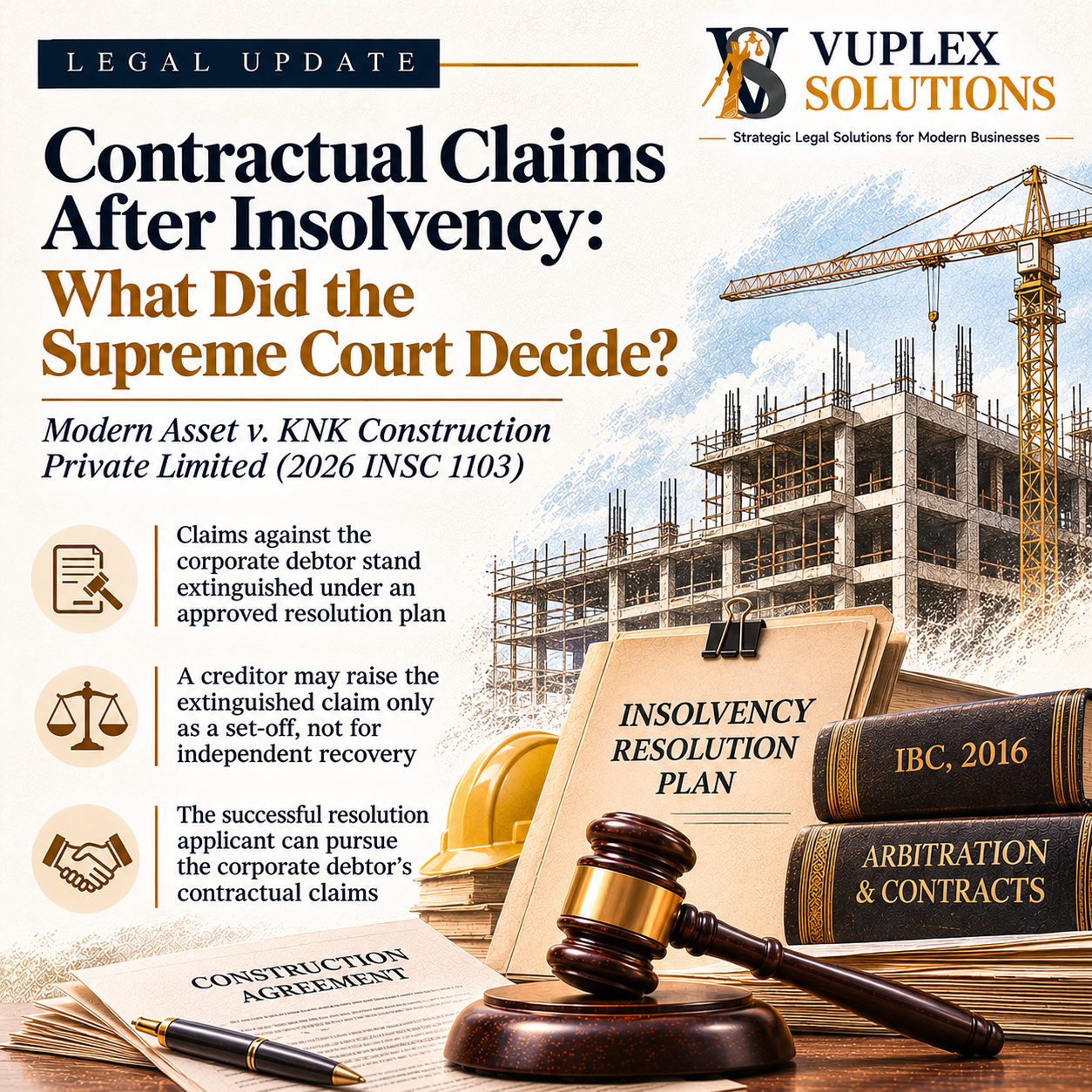
Supreme Court clarifies the treatment of contractual claims, counterclaims and set-off after approval of an insolvency resolution plan.
Commercial disputes do not necessarily end when a company enters the Corporate Insolvency Resolution Process (CIRP). In many cases, businesses continue to face contractual disputes involving unpaid invoices, defective performance, termination of agreements, mobilisation advances, bank guarantees and outstanding contractual liabilities even after a resolution plan has been approved.
A particularly important question arises when both parties to a commercial contract have claims against each other, but one party subsequently undergoes insolvency resolution. Can a successful resolution applicant pursue the corporate debtor's contractual claims while the other party is prevented from recovering its own outstanding dues because of the approved resolution plan?
The Supreme Court recently examined this issue in Modern Asset v. KNK Construction Private Limited, 2026 INSC 1103, decided on October 8, 2026.
The judgment provides important guidance on the interaction between contractual rights, arbitration proceedings and the clean-slate principle under the Insolvency and Bankruptcy Code, 2016 (IBC).
Background: A contractual dispute following insolvency resolution
The dispute arose from a construction agreement dated July 9, 2018, between Modern Asset and KNK Construction Private Limited. The contract, valued at approximately ₹133.68 crore, concerned civil and structural work for an office building and contained an arbitration clause.
Following disputes concerning the performance and termination of the contract, KNK Construction entered CIRP on December 11, 2019.
Modern Asset submitted an operational creditor's claim of approximately ₹12.26 crore before the Resolution Professional. However, under the resolution plan submitted by the erstwhile promoters, only approximately 0.72% of the claim, amounting to ₹8.82 lakh with interest, was provided for payment. The resolution plan was subsequently approved by the National Company Law Tribunal (NCLT) on April 5, 2022.
After the approval of the resolution plan, KNK Construction invoked the arbitration clause and sought recovery of amounts allegedly due from Modern Asset under the same construction agreement.
Modern Asset challenged the continuation of arbitration proceedings. Its principal objection was that its own claim arising from the contract had already been substantially extinguished through the CIRP. Permitting KNK Construction to pursue its contractual claims, while preventing Modern Asset from pursuing its corresponding claims, would create an unequal position between the parties.
The dispute eventually reached the Supreme Court.
The Supreme Court's examination of the clean-slate principle
One of the central principles underlying the IBC is that an approved resolution plan must provide the successful resolution applicant with a defined financial position of the corporate debtor.
Under Section 31(1) of the IBC, an approved resolution plan becomes binding on the corporate debtor and the other persons specified in the provision.
The principle recognised in Ghanshyam Mishra & Sons (P) Ltd. v. Edelweiss Asset Reconstruction Co. Ltd., (2021) 9 SCC 657, is that claims against the corporate debtor which are not provided for in the approved resolution plan stand extinguished, subject to the applicable statutory framework.
This principle is commonly referred to as the clean-slate principle.
The objective is to prevent unresolved historical liabilities from continuing indefinitely against the corporate debtor after completion of the resolution process.
In the present case, the Supreme Court recognised that Modern Asset's claim against the corporate debtor had been dealt with through the approved resolution plan. It could not subsequently seek affirmative recovery of the extinguished balance from the successful resolution applicant.
At the same time, the Court recognised that the successful resolution applicant could pursue claims belonging to the corporate debtor against its debtors. The approval of a resolution plan does not automatically extinguish the corporate debtor's receivables or contractual claims.
The distinction between claims against the corporate debtor and claims belonging to the corporate debtor was therefore central to the Court's reasoning.
Can an extinguished claim still be raised as a counterclaim?
The most significant aspect of the judgment concerns the distinction between an independent claim for recovery and a defensive claim for set-off.
Modern Asset had submitted its claim before the Resolution Professional and had received only a small portion of the amount claimed under the resolution plan.
However, the subsequent arbitration concerned claims arising from the very same contractual relationship.
The Supreme Court considered the circumstances in which the claim had been submitted, the treatment of that claim under the resolution plan and the failure to account for the corporate debtor's corresponding claim during the insolvency process.
The Court relied upon the principle recognised in Ujaas Energy Ltd. v. West Bengal Power Development Corporation Ltd., 2026 SCC OnLine SC 453, concerning the permissible use of an extinguished claim as a defence by way of set-off.
The Court permitted Modern Asset to raise its counterclaim solely for the purpose of set-off, without granting it an independent right to recover the extinguished amount.
Accordingly, if the arbitral tribunal determines that an amount is payable by Modern Asset to KNK Construction, the tribunal must consider the entire claim submitted by Modern Asset during CIRP for the limited purpose of adjusting the amount payable.
However, Modern Asset cannot obtain a positive or affirmative monetary award on the basis of the extinguished claim.
This distinction is fundamental:
- Independent recovery: An extinguished claim cannot ordinarily be revived to obtain a fresh monetary award against the successful resolution applicant.
- Defensive set-off: In the particular circumstances recognised by the Supreme Court, the extinguished claim may be considered to adjust or reduce the amount otherwise found payable to the opposing party.
The judgment therefore preserves the finality of the resolution plan while allowing a limited equitable adjustment between claims arising from the same contractual transaction.
Does approval of a resolution plan extinguish the arbitration agreement?
The proceedings also raised questions concerning the survival of the arbitration agreement after approval of the resolution plan.
The Supreme Court did not accept the argument that the resolution process automatically extinguished the arbitration agreement or prevented the successful resolution applicant from pursuing contractual claims belonging to the corporate debtor.
An arbitration agreement is legally separable from the substantive contractual obligations. Consequently, termination of the underlying contract or approval of a resolution plan does not, by itself, establish that the arbitration agreement has ceased to exist.
The Court did not interfere with the appointment of the arbitral tribunal.
However, it clarified that the tribunal could not reconsider the settled legal position concerning the extinguishment of claims against the corporate debtor under the clean-slate principle.
The tribunal would proceed with the surviving disputes in accordance with the Supreme Court's directions, including the limited set-off permitted in favour of Modern Asset.
Why the judgment matters for contractors, MSMEs and operational creditors
The decision has practical implications for businesses engaged in construction contracts, infrastructure projects, supply arrangements and other long-term commercial transactions.
1. Submission of claims during CIRP requires careful assessment
Operational creditors should ensure that their claims are accurately quantified, supported by contractual records and submitted within the applicable insolvency framework. Invoices, running account bills, measurement books, completion certificates, correspondence, termination notices and bank guarantee records may become important in establishing the nature and extent of contractual liabilities.
2. Counterclaims should not be overlooked during insolvency proceedings
A corporate debtor may have independent contractual claims against another party even where that party has submitted a claim against the corporate debtor. The information memorandum and relevant insolvency records should accurately disclose disputes by and against the corporate debtor. Failure to properly identify and account for such disputes may create complications after approval of the resolution plan.
3. An approved resolution plan has binding consequences
A creditor whose claim has been dealt with under an approved resolution plan cannot ordinarily reopen the extinguished balance through subsequent proceedings. The extent of recovery must be examined with reference to the approved plan and the applicable provisions of the IBC.
4. Set-off and recovery are legally distinct remedies
The judgment makes clear that permission to raise a claim as a defensive set-off does not amount to restoration of an extinguished cause of action for independent recovery. Businesses involved in arbitration following insolvency resolution must carefully distinguish between these two forms of relief.
5. Contractual documentation remains critical
Commercial agreements should clearly address payment obligations, performance milestones, termination consequences, bank guarantees, indemnities, dispute resolution and the treatment of outstanding liabilities. Where disputes arise, contemporaneous documentation and timely legal action can materially affect the available remedies.
What businesses should consider before entering into or terminating commercial contracts
The judgment also highlights the importance of managing contractual disputes before they develop into prolonged insolvency and arbitration proceedings. Businesses should pay particular attention to:
- Clearly drafted arbitration and dispute-resolution clauses.
- Accurate maintenance of contractual accounts and outstanding payment records.
- Timely issuance of notices concerning breach, delay and defective performance.
- Proper documentation of termination and invocation of bank guarantees.
- Identification of reciprocal claims and liabilities before submitting or evaluating a resolution plan.
- Timely submission and verification of claims during CIRP.
- Appropriate legal assessment of limitation periods and the effect of the insolvency moratorium.
The treatment of contractual claims during insolvency is not merely an accounting exercise. It involves statutory compliance, procedural timelines and the legal consequences of an approved resolution plan.
Download Full Report
Get complete access to the detailed legal analysis on contractual claims, counterclaims, and defensive set-off after resolution plan approval.
Download Document (.docx)Conclusion
The Supreme Court's decision in Modern Asset v. KNK Construction Private Limited reinforces the importance of understanding how insolvency resolution affects existing contractual rights and remedies.
The judgment preserves the clean-slate principle under the IBC while recognising that, in the particular circumstances before it, an extinguished claim may be considered for defensive set-off without permitting independent recovery.
For businesses, contractors and operational creditors, the decision serves as an important reminder that contractual claims must be identified, documented and appropriately pursued during insolvency proceedings.
Where commercial contracts and insolvency proceedings intersect, the distinction between an extinguished claim, a surviving receivable and a permissible defensive set-off can determine the extent of a party's legal remedies.
More Insights
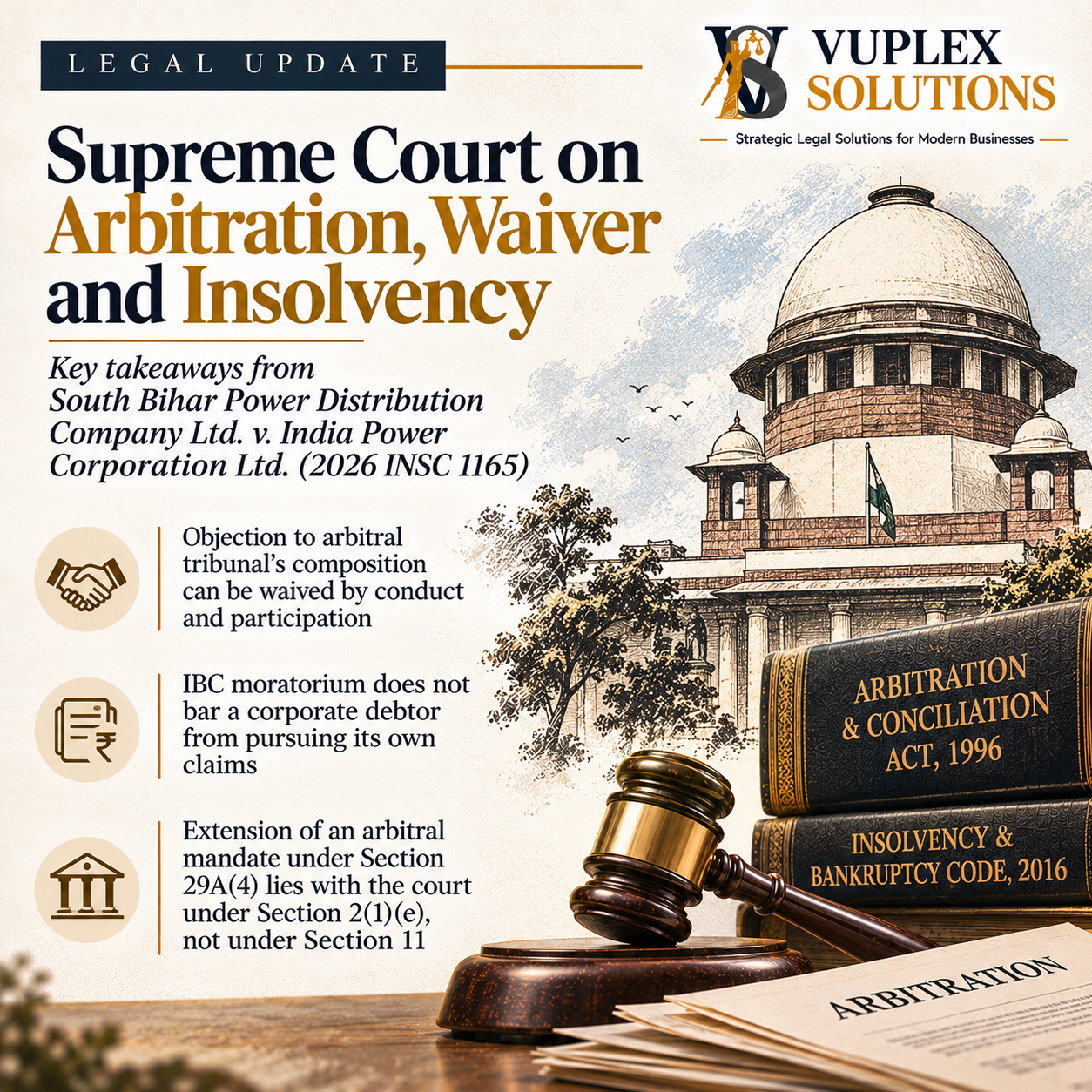
Arbitration Clauses, Waiver and Insolvency: Supreme Court Clarifies Limits of Objections
In South Bihar Power Distribution Company Ltd. v. India Power Corporation Ltd. (2026 INSC 1165), the Supreme Court clarifies waiver of tribunal composition objections, corporate debtor claims during IBC moratorium, and Section 29A(4) jurisdiction.
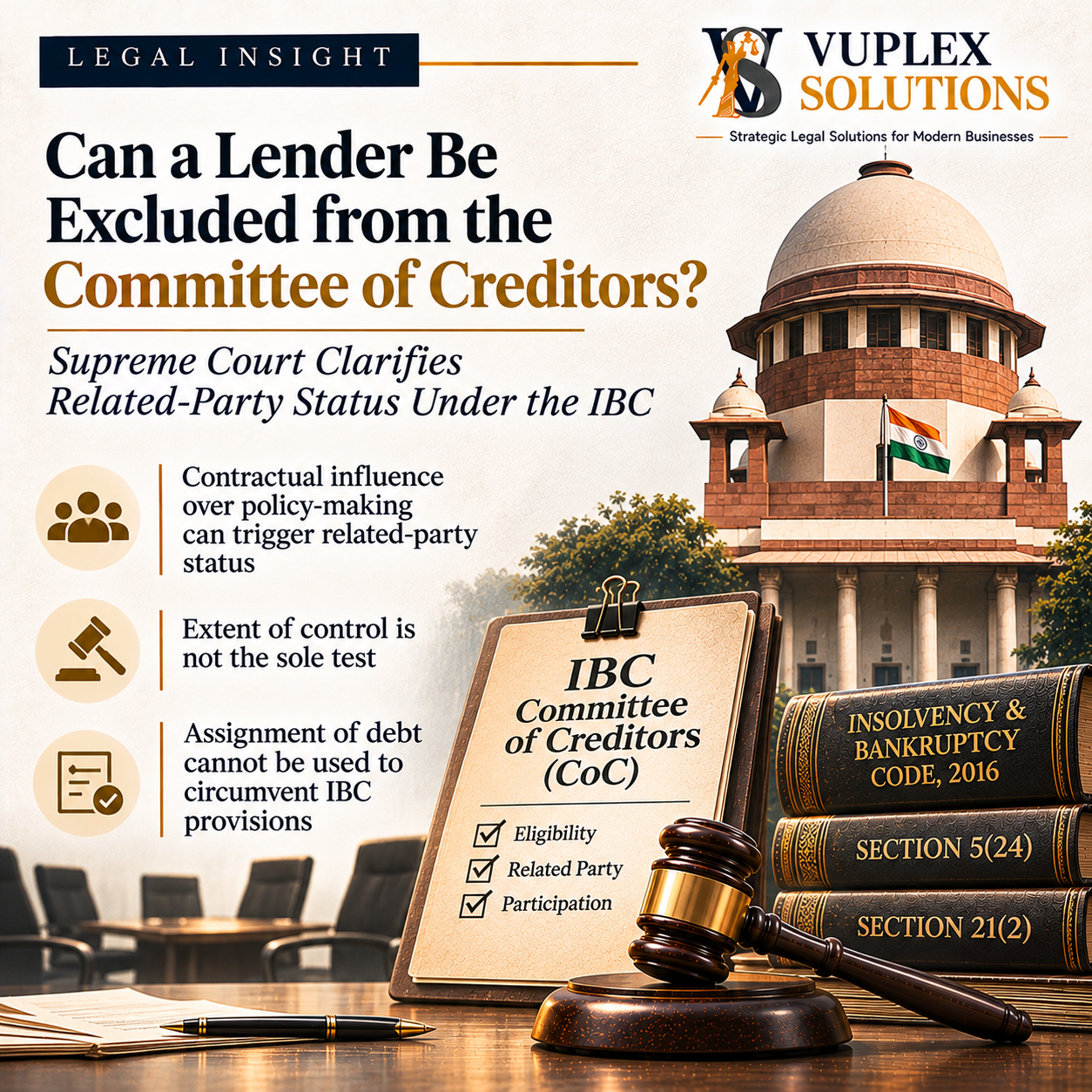
Can a Lender Be Excluded from the Committee of Creditors? Supreme Court on IBC
In ECL Finance Ltd. v. Abhinav Mukherjee (2026 INSC 1159), the Supreme Court clarifies that contractual influence over a corporate debtor's policy-making can trigger related-party disqualification from the CoC under the IBC.
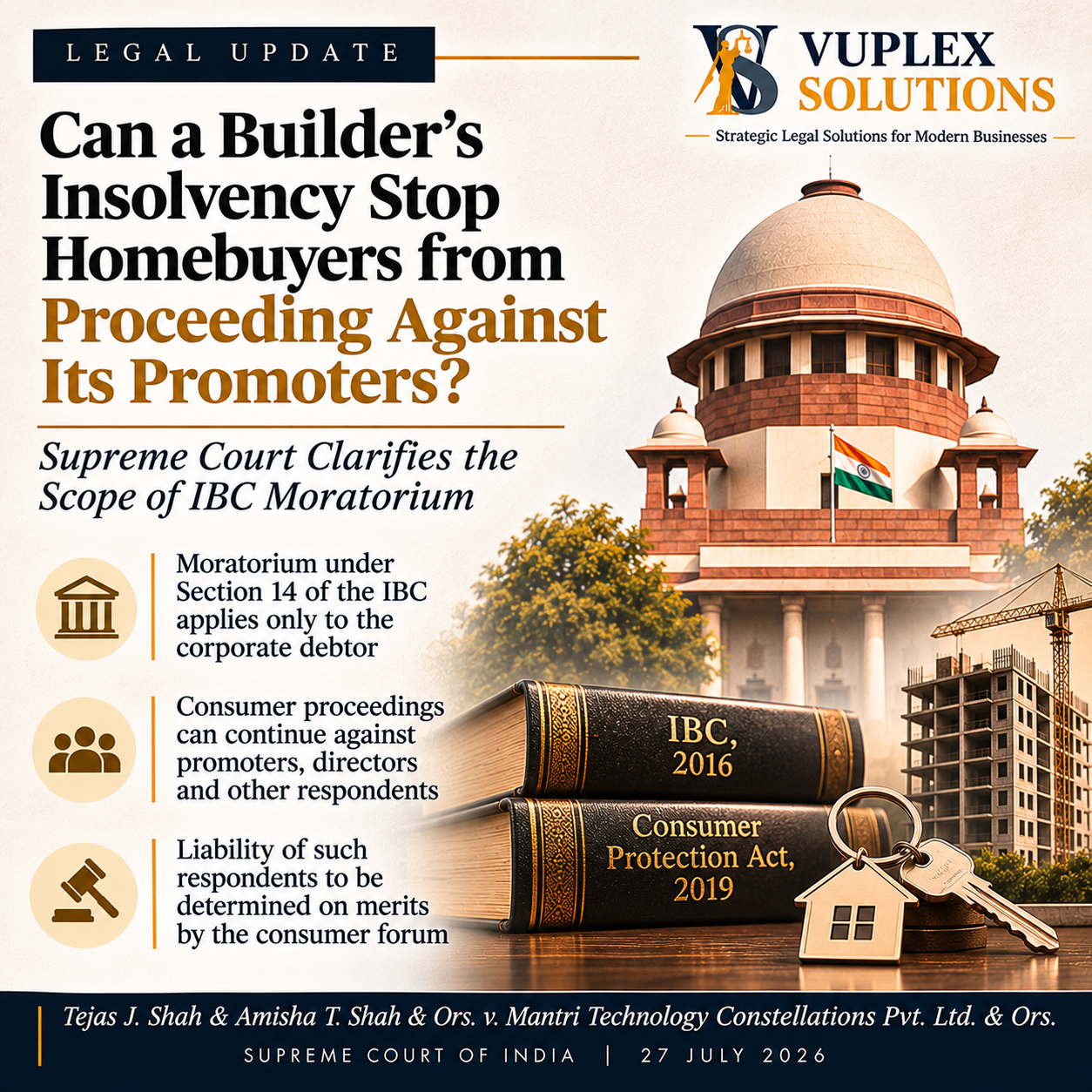
Can a Builder’s Insolvency Stop Homebuyers from Proceeding Against Promoters?
In Tejas J. Shah v. Mantri Technology Constellations Pvt. Ltd. (2026 INSC 746), the Supreme Court holds that the Section 14 IBC moratorium applies solely to the corporate debtor and does not shield promoters or directors from consumer claims.