Can a Builder’s Insolvency Stop Homebuyers from Proceeding Against Its Promoters? Supreme Court Clarifies the Scope of IBC Moratorium
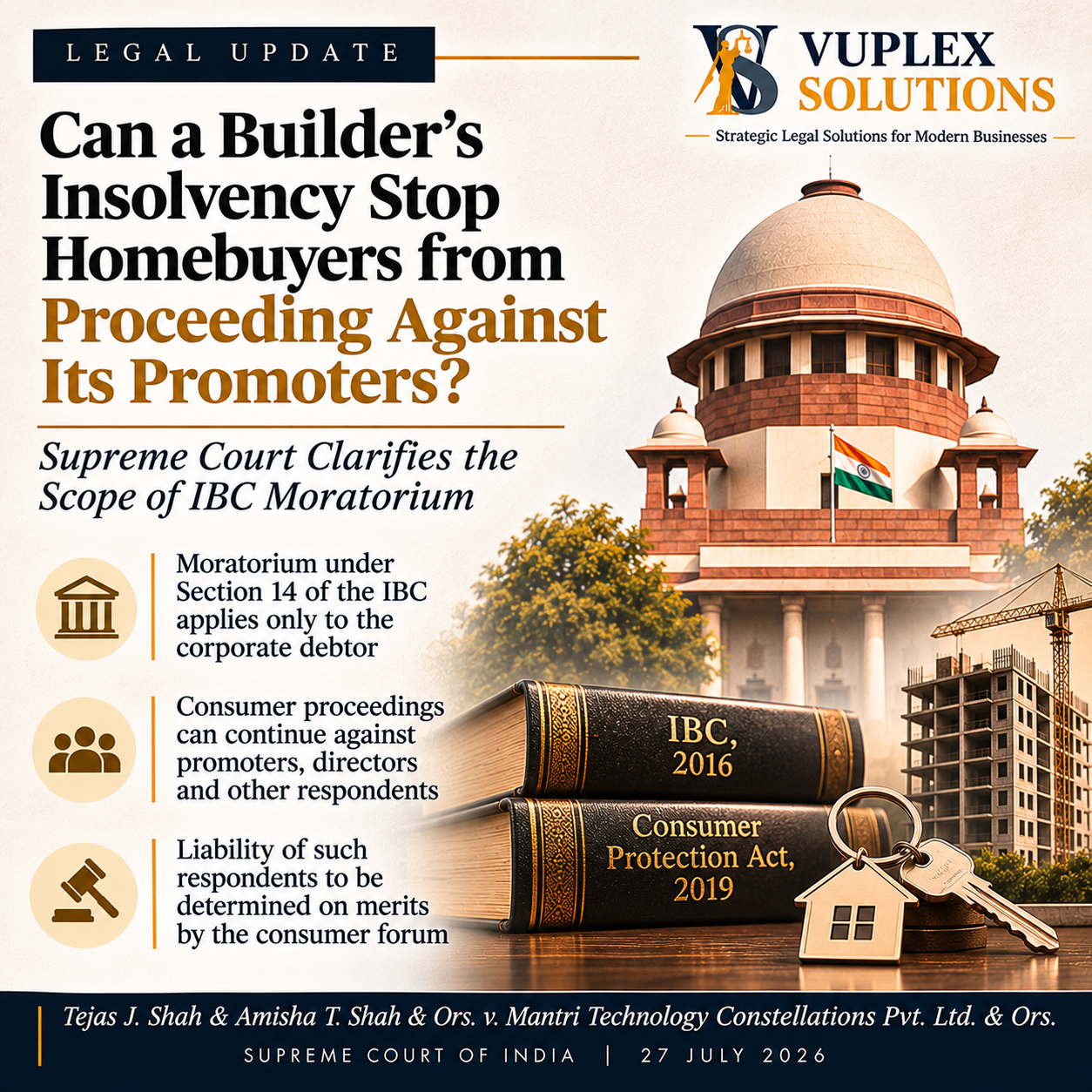
A moratorium against a real estate developer does not automatically protect its promoters, directors or other respondents from consumer proceedings.
Introduction
For homebuyers, a real estate project entering insolvency can create a complicated legal situation. While the corporate insolvency resolution process (CIRP) may suspend proceedings against the developer company, questions often arise regarding the remedies available against its promoters, directors, associated entities and other parties connected with the project.
A significant question in this context is whether the insolvency of the developer automatically brings all consumer proceedings arising out of the project to a halt.
The Supreme Court of India addressed this issue in Tejas J. Shah & Amisha T. Shah & Ors. v. Mantri Technology Constellations Private Limited (now known as Buoyant Technology Constellations Private Limited) & Ors., 2026 INSC 746, decided on 27 July 2026.
The Court clarified that the moratorium under Section 14 of the Insolvency and Bankruptcy Code, 2016 (IBC), operates against the corporate debtor alone. It cannot automatically be extended to promoters, directors or other respondents who are not themselves protected by the moratorium.
The judgment is particularly relevant to homebuyers seeking to pursue consumer remedies where the developer company has entered insolvency proceedings.
Background of the Dispute
The dispute arose from the residential project Mantri Manyata Energia, developed by Mantri Technology Constellations Private Limited.
The appellants had booked residential apartments in the project in 2016. Under the relevant agreements, possession was scheduled to be handed over on or before 31 December 2018. According to the homebuyers, despite substantial payments and repeated assurances, possession was not delivered within the stipulated period.
The homebuyers, along with others, instituted a consumer complaint before the National Consumer Disputes Redressal Commission (NCDRC), alleging deficiency in service and unfair trade practices.
The complaint was instituted against multiple respondents, including:
- The developer company;
- An associated developer company;
- Promoters and directors of the companies; and
- The landowners of the project.
During the pendency of the consumer complaint, the National Company Law Tribunal (NCLT), Bengaluru Bench, admitted an application under Section 9 of the IBC against the principal developer on 23 August 2024. Consequently, a moratorium under Section 14 came into operation against that company.
The homebuyers thereafter requested the NCDRC to continue hearing the consumer complaint against the remaining respondents, notwithstanding the moratorium applicable to the developer.
The NCDRC rejected their applications and adjourned the entire consumer complaint sine die, taking the view that the alleged deficiency in service could not be examined independently against the remaining respondents while the developer was undergoing CIRP.
The matter ultimately reached the Supreme Court.
The Legal Issue: Does Section 14 Protect Only the Corporate Debtor or Its Promoters and Directors as Well?
Section 14 of the IBC provides for a moratorium upon commencement of the insolvency resolution process. Among other restrictions, it prohibits the institution or continuation of suits and proceedings against the corporate debtor, including execution proceedings.
The purpose of the moratorium is to preserve the assets of the corporate debtor and provide a protected environment for the resolution process.
However, the statutory protection raises an important distinction between the corporate debtor and other legal persons associated with it.
A company has a legal identity separate from its promoters, directors, shareholders and associated entities. The mere fact that these persons are connected with the corporate debtor does not, by itself, make them beneficiaries of the moratorium under Section 14.
The Supreme Court reiterated that the scope of the moratorium is determined by the statute and cannot be enlarged beyond its prescribed limits.
What Did the Supreme Court Hold?
The Supreme Court found the NCDRC's approach erroneous.
The Court observed that the CIRP had been initiated only against Respondent No. 1, the principal developer. No independent moratorium or statutory protection operated in favour of Respondents Nos. 2 to 7.
Accordingly, there was no statutory bar preventing the consumer complaint from proceeding against the remaining respondents.
The Court emphasised that the question before the NCDRC at the interlocutory stage was not whether the other respondents were ultimately liable for the alleged deficiency in service. The immediate question was whether the proceedings could legally continue against them despite the moratorium applicable to the developer.
The NCDRC had effectively prejudged the issue by concluding that the alleged deficiency was attributable only to the corporate debtor, even though the liability of the remaining respondents had not yet been adjudicated.
The Supreme Court held that the Commission was required to examine the complaint against those respondents and determine their liability after considering the rival pleadings and objections.
Importantly, the Court did not hold the promoters, directors or landowners liable. It only clarified that the consumer proceedings against them could not be discontinued merely because the principal developer was undergoing CIRP.
Reliance on Earlier Supreme Court Decisions
The Court's reasoning was consistent with its earlier decisions concerning the limited scope of the IBC moratorium.
1. P. Mohanraj v. Shah Brothers Ispat Private Limited, (2021) 6 SCC 258
In this decision, the Supreme Court examined the applicability of Section 14 to proceedings under Section 138 of the Negotiable Instruments Act, 1881. The Court recognised that the moratorium operates against the corporate debtor and does not automatically extend to natural persons who may independently face liability under the applicable law.
2. Ansal Crown Heights Flat Buyers Association v. Ansal Crown Infrabuild Private Limited, (2024) 5 SCC 745
This decision addressed the protection available to promoters and directors when a moratorium operates against a real estate developer. The Supreme Court clarified that the moratorium against the corporate debtor does not, by itself, confer protection upon its promoters and directors.
3. Saranga Anilkumar Aggarwal v. Bhavesh Dhirajlal Sheth & Ors., 2025 INSC 314
The Court also referred to the principle that the protective scope of a moratorium must remain within the limits prescribed by the statute and should not be expanded in a manner that unnecessarily restricts remedies available under other laws.
These authorities reinforced the principle that insolvency protection must be applied in accordance with the statutory framework rather than extended to every person associated with the corporate debtor.
Why This Judgment Matters for Homebuyers
The decision is significant because real estate projects frequently involve multiple legal entities and stakeholders. The developer, landowner, project management company, holding company and promoters may all have distinct contractual or statutory roles. When the principal developer enters CIRP, homebuyers may face difficulty in pursuing proceedings involving other respondents.
The Supreme Court's ruling clarifies that the commencement of CIRP against one company does not automatically require a consumer forum to suspend the entire complaint. The judgment has the following practical implications:
1. Consumer proceedings may continue against non-corporate respondents
Where the moratorium applies only to the developer company, proceedings against other respondents are not automatically barred. Their liability must be examined independently in accordance with law.
2. Promoters and directors do not receive automatic immunity
A promoter or director cannot claim protection under Section 14 merely because of their association with the corporate debtor. However, whether an individual respondent is actually liable will depend upon the pleadings, contractual obligations and evidence.
3. Consumer remedies are not automatically extinguished by CIRP
The commencement of insolvency proceedings against a developer does not, by itself, eliminate every remedy available to homebuyers under the Consumer Protection Act, 2019.
4. Liability must be determined on its own merits
The continuation of proceedings does not establish liability. Respondents may still raise objections relating to maintainability, absence of privity of contract and the absence of any independent legal obligation.
What the Judgment Does Not Decide
The decision must be understood within the limits of the question before the Supreme Court.
The Court did not direct the NCDRC to grant compensation or hold the promoters and other respondents liable. It expressly declined to decide the objections concerning privity of contract, maintainability and the existence of independent obligations. Those questions were left to the NCDRC for adjudication in accordance with law.
Further, the proceedings against the principal developer were expressly held to remain governed by the moratorium under Section 14 of the IBC.
Therefore, the judgment does not create an unrestricted right to proceed against every person associated with an insolvent company. A complainant must still establish an appropriate legal basis for the relief sought against each respondent.
Download Full Report
Get complete access to the detailed legal analysis on the scope of Section 14 IBC moratorium and consumer remedies against real estate promoters.
Download Document (.docx)Conclusion
The Supreme Court's decision in Tejas J. Shah & Amisha T. Shah v. Mantri Technology Constellations Private Limited reinforces an important distinction in insolvency law: the statutory protection available to a corporate debtor cannot automatically be extended to every person associated with it.
For homebuyers, the ruling provides clarity that the insolvency of a developer does not necessarily bring the entire consumer dispute to an end. Where other respondents are not protected by the moratorium, the consumer forum must examine whether proceedings can continue against them and determine their liability on the merits.
The judgment also serves as a reminder that the IBC and the Consumer Protection Act operate within their respective statutory frameworks. The commencement of a corporate insolvency resolution process must not be treated as an automatic answer to every claim arising out of a real estate transaction.
Case Reference & Key Provisions
Case Reference: Tejas J. Shah & Amisha T. Shah & Ors. v. Mantri Technology Constellations Private Limited (now known as Buoyant Technology Constellations Private Limited) & Ors., 2026 INSC 746, decided on 27 July 2026.
Bench: Justice Vikram Nath and Justice Sandeep Mehta.
Relevant Provisions: Section 14, Insolvency and Bankruptcy Code, 2016; Consumer Protection Act, 2019.
More Insights
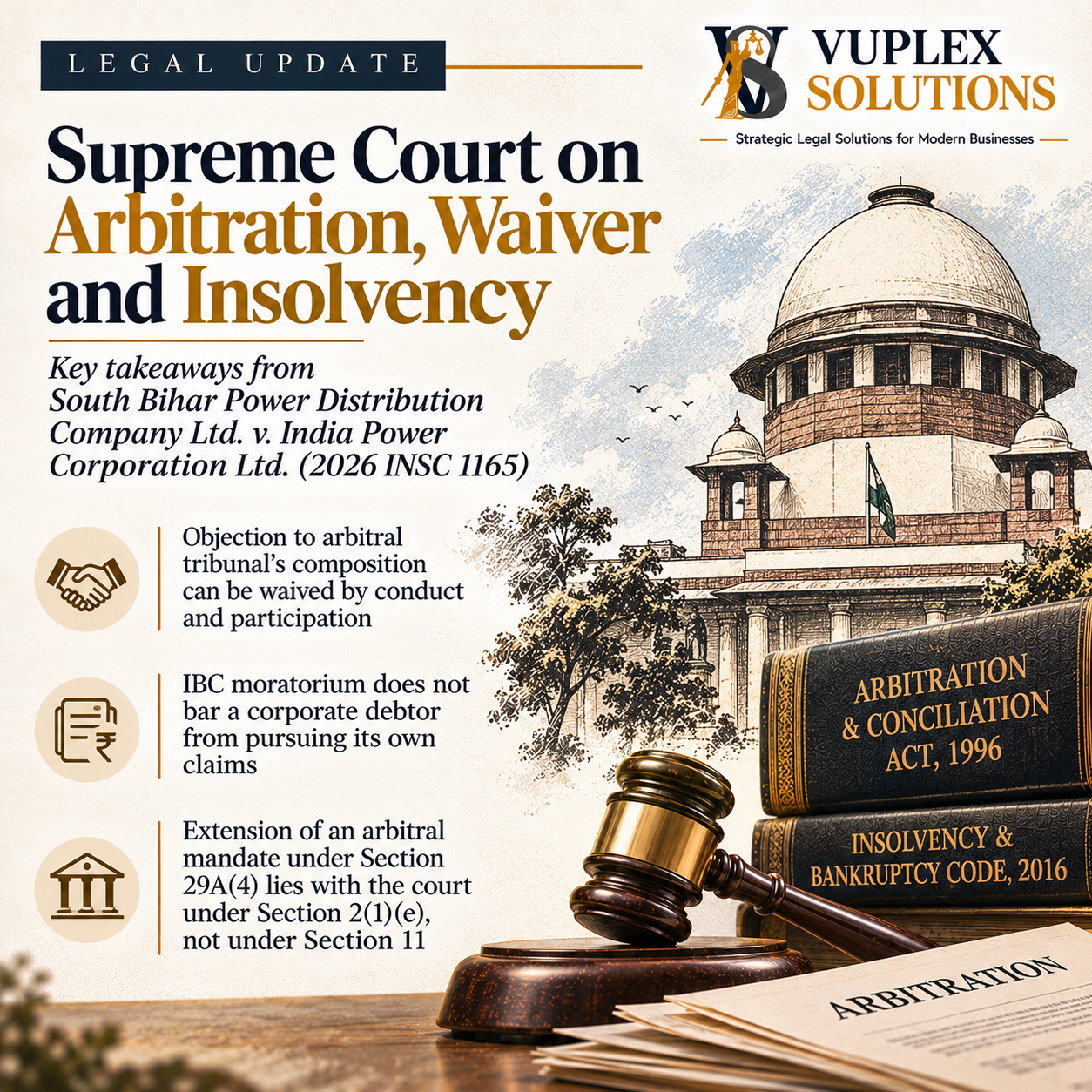
Arbitration Clauses, Waiver and Insolvency: Supreme Court Clarifies Limits of Objections
In South Bihar Power Distribution Company Ltd. v. India Power Corporation Ltd. (2026 INSC 1165), the Supreme Court clarifies waiver of tribunal composition objections, corporate debtor claims during IBC moratorium, and Section 29A(4) jurisdiction.
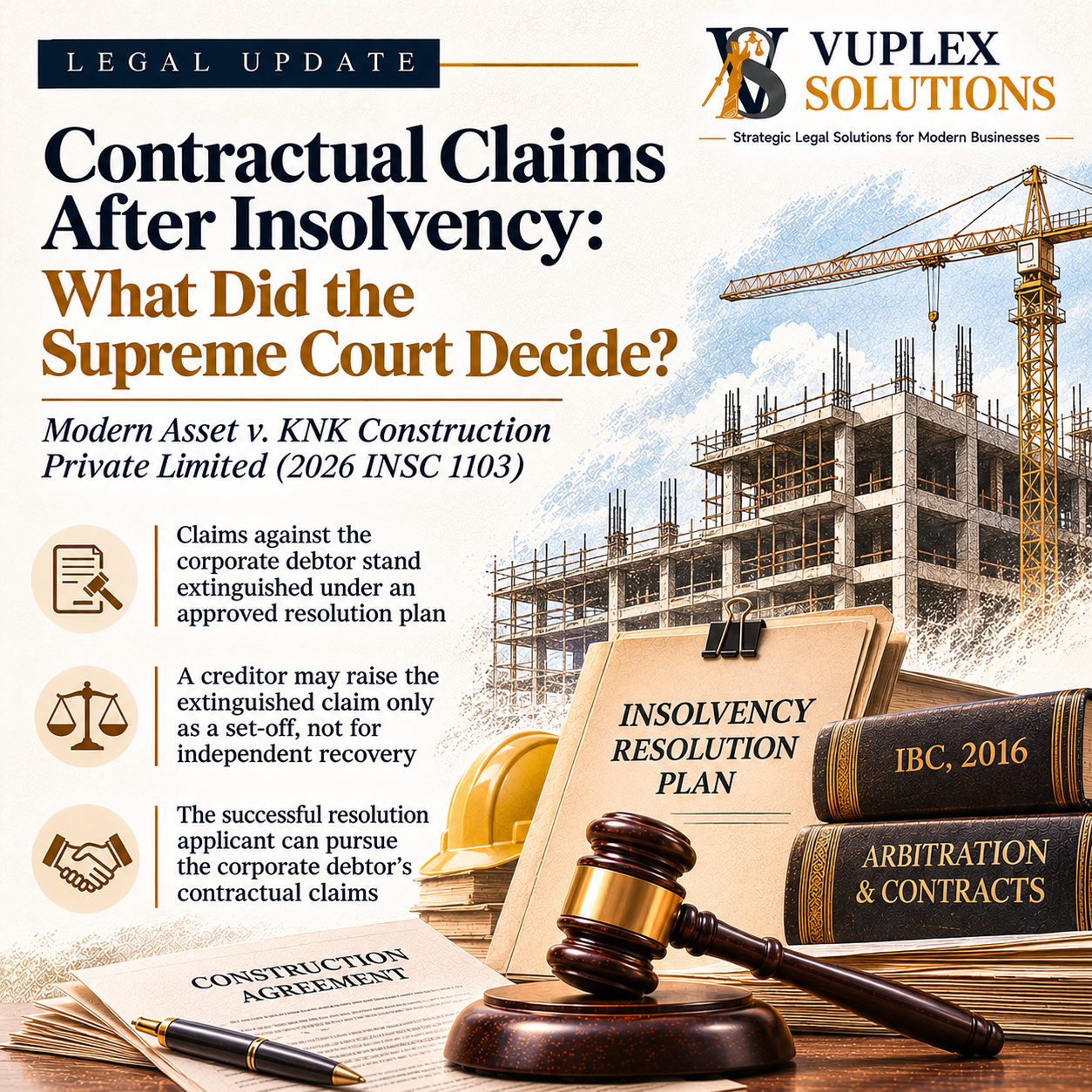
Can You Still Claim Money Under a Contract After Insolvency?
In Modern Asset v. KNK Construction Private Limited (2026 INSC 1103), the Supreme Court clarifies how the clean-slate principle under IBC treats contractual claims, surviving arbitration clauses, and defensive set-off.
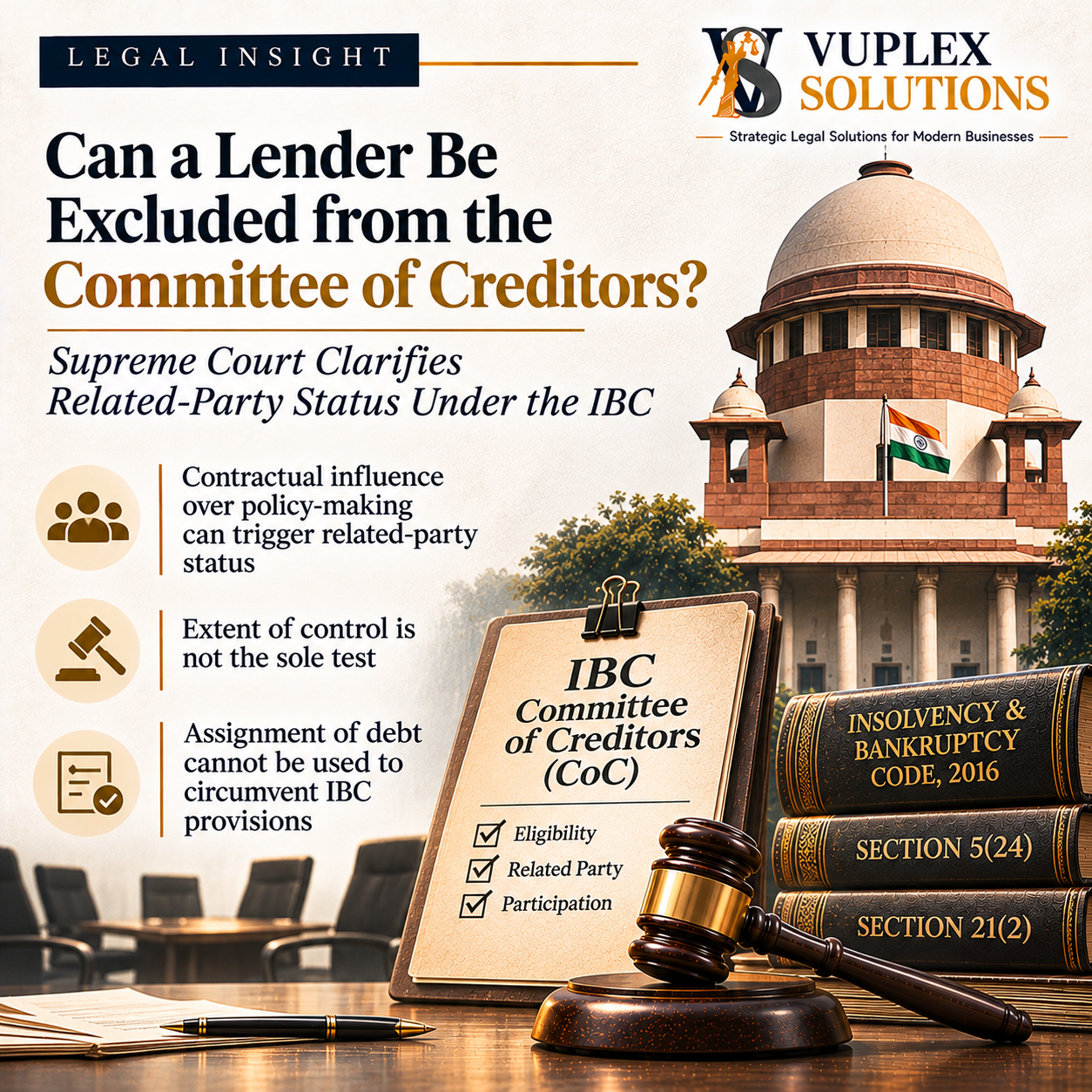
Can a Lender Be Excluded from the Committee of Creditors? Supreme Court on IBC
In ECL Finance Ltd. v. Abhinav Mukherjee (2026 INSC 1159), the Supreme Court clarifies that contractual influence over a corporate debtor's policy-making can trigger related-party disqualification from the CoC under the IBC.