Arbitration Clauses, Waiver and Insolvency: Supreme Court Clarifies the Limits of Objections to Arbitral Proceedings
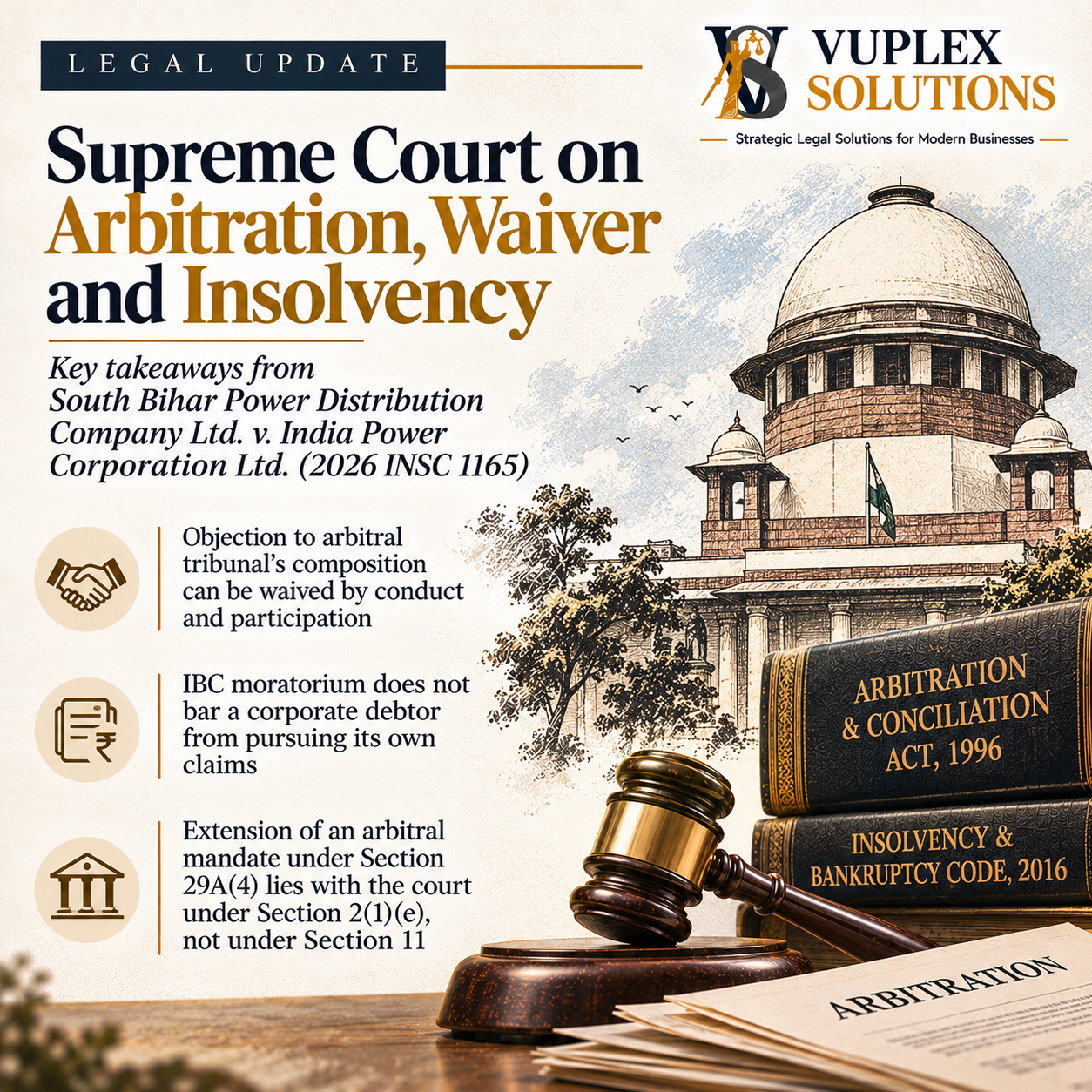
In South Bihar Power Distribution Company Ltd. v. India Power Corporation Ltd. & Anr., 2026 INSC 1165, decided on October 28, 2026, the Supreme Court examined the consequences of participating in arbitration without objecting to the constitution of the tribunal, the effect of an insolvency moratorium on claims pursued by a corporate debtor, and the jurisdiction of courts to extend the mandate of an arbitral tribunal under Section 29A of the Arbitration and Conciliation Act, 1996.
The judgment addresses three distinct but commercially significant aspects of arbitration law. It reinforces the importance of raising jurisdictional objections at the appropriate stage, clarifies that insolvency proceedings do not necessarily prevent a corporate debtor from pursuing its own claims, and identifies the court competent to extend the time for making an arbitral award.
Background of the dispute
The dispute arose out of a Distribution Franchisee Agreement dated December 31, 2013, involving South Bihar Power Distribution Company Limited, India Power Corporation Limited and its special purpose vehicle, India Power Corporation (Bodhgaya) Limited.
The agreement contained an arbitration clause providing for the constitution of a three-member arbitral tribunal.
Following disputes between the parties, arbitration proceedings were initiated. In 2018, the Patna High Court appointed a sole arbitrator with the consent of the parties. Subsequently, when the first arbitrator could not continue, another sole arbitrator was appointed by the High Court in March 2021, again with the parties' consent.
The proceedings continued before the sole arbitrator. The parties participated in the arbitration, and the appellant also filed a counter-claim and a supplementary counter-claim.
Meanwhile, insolvency proceedings were initiated against the special purpose vehicle under the Insolvency and Bankruptcy Code, 2016.
The dispute subsequently expanded to include objections concerning the composition of the arbitral tribunal, the authority of the corporate debtor to pursue arbitration during the moratorium, and the jurisdiction of the High Court to extend the arbitrator's mandate.
Whether participation before a sole arbitrator amounts to waiver of the agreed tribunal composition
One of the principal issues before the Supreme Court concerned the appellant's objection that the arbitration agreement contemplated a three-member tribunal, whereas the proceedings had continued before a sole arbitrator.
The appellant sought to rely on the original contractual stipulation despite having participated in proceedings before the sole arbitrator and having filed counter-claims.
The Supreme Court examined the objection in the context of Sections 4 and 16(2) of the Arbitration and Conciliation Act, 1996.
Section 4 deals with the waiver of the right to object where a party, knowing that a derogable provision of the Act or a requirement under the arbitration agreement has not been complied with, proceeds with the arbitration without raising an objection within the prescribed time.
Section 16(2), in turn, requires a plea that the arbitral tribunal lacks jurisdiction to be raised no later than the submission of the statement of defence, subject to the statutory framework.
The Court found that the appellant had consented to the appointment of the sole arbitrators, participated in the proceedings, consented to extensions of time and filed counter-claims. It had also failed to challenge the earlier appointment orders at the appropriate stage.
In these circumstances, the Court held that the appellant had waived its right to object to the composition of the tribunal.
The judgment reinforces an important principle: a party cannot ordinarily participate in arbitral proceedings, take steps in furtherance of those proceedings and subsequently challenge the tribunal's composition at a belated stage after having failed to raise the objection within the statutory timeframe.
This does not mean that every objection concerning the constitution of an arbitral tribunal is automatically waived by participation. The statutory requirements, the nature of the objection and the conduct of the parties remain relevant.
Does the Section 14 IBC moratorium prevent a corporate debtor from pursuing its own arbitration claim?
The second issue concerned the effect of the moratorium under Section 14 of the Insolvency and Bankruptcy Code, 2016.
The appellant questioned the continuation of arbitration proceedings involving the corporate debtor after commencement of the corporate insolvency resolution process.
Section 14 imposes a moratorium restricting specified proceedings and actions against the corporate debtor. Its purpose is to protect the corporate debtor's assets and prevent individual enforcement actions from disrupting the collective insolvency resolution process.
The Supreme Court clarified that the moratorium does not necessarily prevent the corporate debtor from initiating proceedings to recover its own dues.
The Court distinguished between proceedings directed against the corporate debtor and proceedings initiated by the corporate debtor for recovery of amounts owed to it.
An arbitral claim pursued by the corporate debtor may, if successful, improve its financial position and enhance the value available within the insolvency process.
The Court also took note of the authorisation granted by the resolution professional, with the approval of the Committee of Creditors under Section 28(1)(h) of the IBC.
Accordingly, the Court held that Section 14 does not prohibit a corporate debtor from initiating an arbitral proceeding for recovery of its dues.
This clarification is significant for businesses undergoing CIRP. The commencement of insolvency proceedings does not, by itself, extinguish the corporate debtor's ability to pursue contractual receivables or other claims. Such proceedings must, however, be undertaken through the appropriate insolvency-management framework and with the necessary authorisations.
Who has jurisdiction to extend the mandate of an arbitral tribunal under Section 29A(4)?
The third issue concerned the interpretation of Section 29A(4) of the Arbitration and Conciliation Act, 1996.
Section 29A governs the time limit for making an arbitral award and provides for judicial extension of the mandate in the circumstances specified therein.
The question before the Supreme Court was whether the High Court, acting through the Chief Justice or a designate under Section 11 of the Act, could exercise the power to extend the arbitral tribunal's mandate under Section 29A(4).
The Supreme Court held that the jurisdiction to grant such an extension vests in the court defined under Section 2(1)(e) of the Arbitration and Conciliation Act, 1996.
For domestic arbitration, this ordinarily means the principal civil court of original jurisdiction in a district, or a High Court exercising ordinary original civil jurisdiction, having jurisdiction over the subject matter of the arbitration.
The Court clarified that the role of the High Court under Section 11 concerns the appointment of arbitrators in the circumstances contemplated by that provision. That jurisdiction cannot be expanded to confer upon the High Court, acting under Section 11, the power to extend the mandate under Section 29A(4).
Consequently, the Supreme Court set aside the Patna High Court's interpretation on this particular issue.
Importantly, the Court noted that the Commercial Court at Patna had already extended the arbitral tribunal's mandate by six months on March 23, 2026. Therefore, setting aside the High Court's view on jurisdiction did not disturb the extension already granted by the competent Commercial Court.
What did the Supreme Court ultimately decide?
The Supreme Court affirmed the Patna High Court's findings on the first two issues:
- The appellant had waived its objection to the constitution of a sole-member tribunal through its conduct and failure to raise the objection at the appropriate stage.
- Section 14 of the IBC did not prevent the corporate debtor from pursuing its own arbitral claim for recovery of dues.
However, the Court set aside the High Court's finding that the Chief Justice or a designate exercising jurisdiction under Section 11 could extend the arbitral tribunal's mandate under Section 29A(4).
The Supreme Court also lifted the embargo previously imposed on the pronouncement of the arbitral award and directed the arbitrator to deliver the award within six weeks.
The civil appeals were accordingly dismissed without any order as to costs.
Practical implications for commercial contracts and arbitration proceedings
The judgment has practical significance for parties entering into commercial agreements containing arbitration clauses.
First, objections to the constitution of an arbitral tribunal must be raised at the appropriate stage. Parties should examine the arbitration agreement and the proposed constitution of the tribunal before participating in substantive proceedings. Delayed objections may be treated as waived where the statutory conditions are satisfied.
Second, participation in arbitration carries procedural consequences. Filing pleadings, submitting counter-claims, consenting to procedural extensions and proceeding without objection may be relevant in determining whether a party has acquiesced in the constitution of the tribunal.
Third, insolvency does not necessarily suspend the corporate debtor's affirmative claims. A company undergoing CIRP may continue to pursue claims that can augment its assets, subject to the IBC framework and the requisite authorisation.
Fourth, applications for extension of an arbitral mandate must be presented before the competent court. Parties should carefully distinguish between the jurisdiction exercised under Section 11 for appointment of arbitrators and the jurisdiction contemplated under Section 29A(4) for extension of the tribunal's mandate.
These considerations are particularly relevant in long-running commercial disputes where arbitration proceedings overlap with insolvency proceedings, contractual claims and questions concerning the authority of the resolution professional.
Download Full Report
Get complete access to the detailed legal analysis on arbitration waiver, Section 14 IBC moratorium, and Section 29A(4) mandate extension.
Download Document (.docx)Conclusion
The Supreme Court's decision in South Bihar Power Distribution Company Ltd. v. India Power Corporation Ltd. & Anr. clarifies important procedural aspects of domestic arbitration and its interaction with the insolvency framework.
The judgment emphasises that the right to challenge the composition of an arbitral tribunal must be exercised within the statutory framework, that the moratorium under Section 14 of the IBC does not automatically prevent a corporate debtor from pursuing its own claims, and that the power to extend an arbitral mandate under Section 29A(4) must be exercised by the court identified under Section 2(1)(e) of the Arbitration and Conciliation Act, 1996.
For commercial entities, the decision underscores the importance of careful arbitration-clause drafting, timely procedural objections and a clear understanding of the respective jurisdictions of courts and arbitral tribunals.
Ultimately, the judgment demonstrates that procedural conduct during arbitration can have consequences as significant as the contractual rights forming the subject matter of the dispute.
More Insights

Can You Still Claim Money Under a Contract After Insolvency?
In Modern Asset v. KNK Construction Private Limited (2026 INSC 1103), the Supreme Court clarifies how the clean-slate principle under IBC treats contractual claims, surviving arbitration clauses, and defensive set-off.
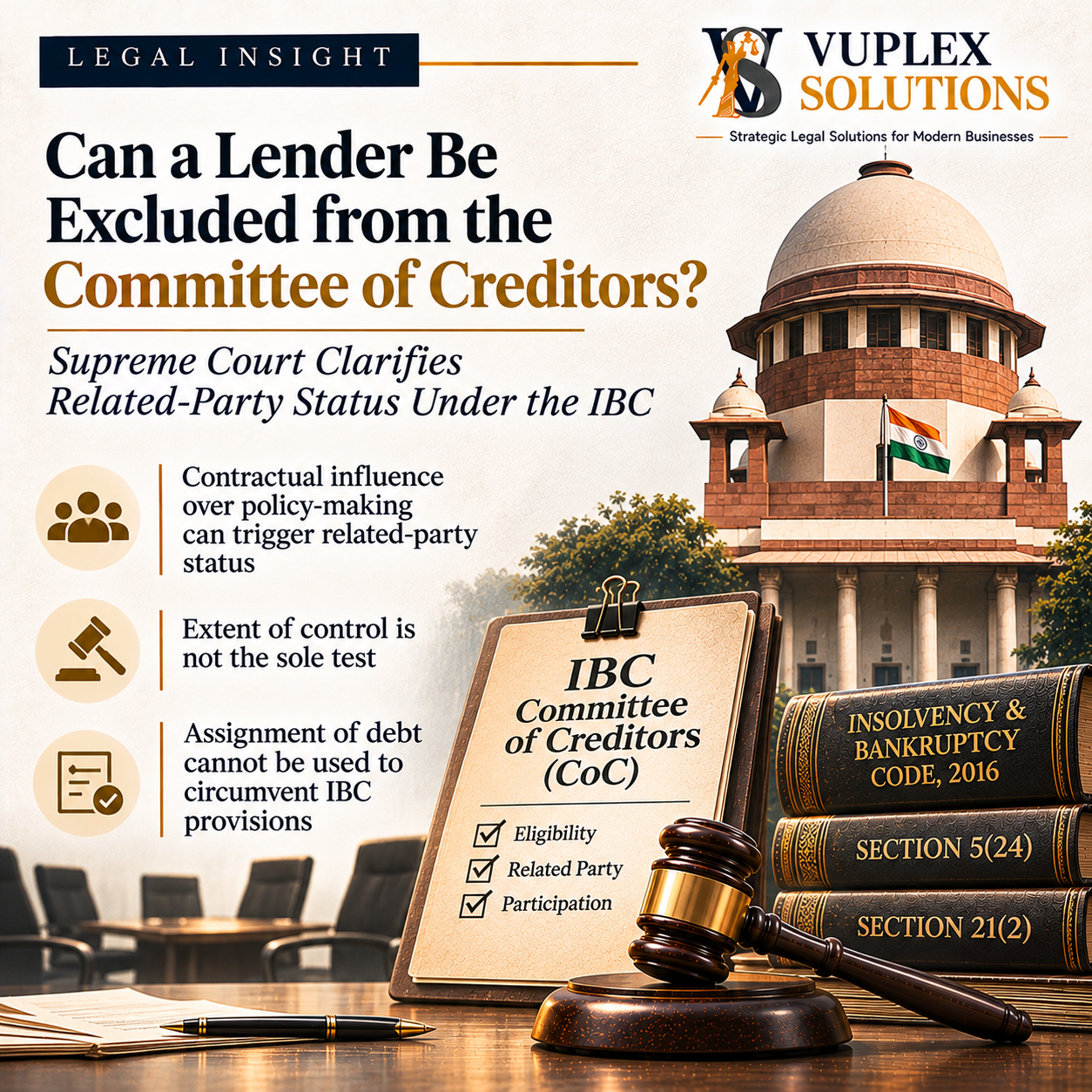
Can a Lender Be Excluded from the Committee of Creditors? Supreme Court on IBC
In ECL Finance Ltd. v. Abhinav Mukherjee (2026 INSC 1159), the Supreme Court clarifies that contractual influence over a corporate debtor's policy-making can trigger related-party disqualification from the CoC under the IBC.
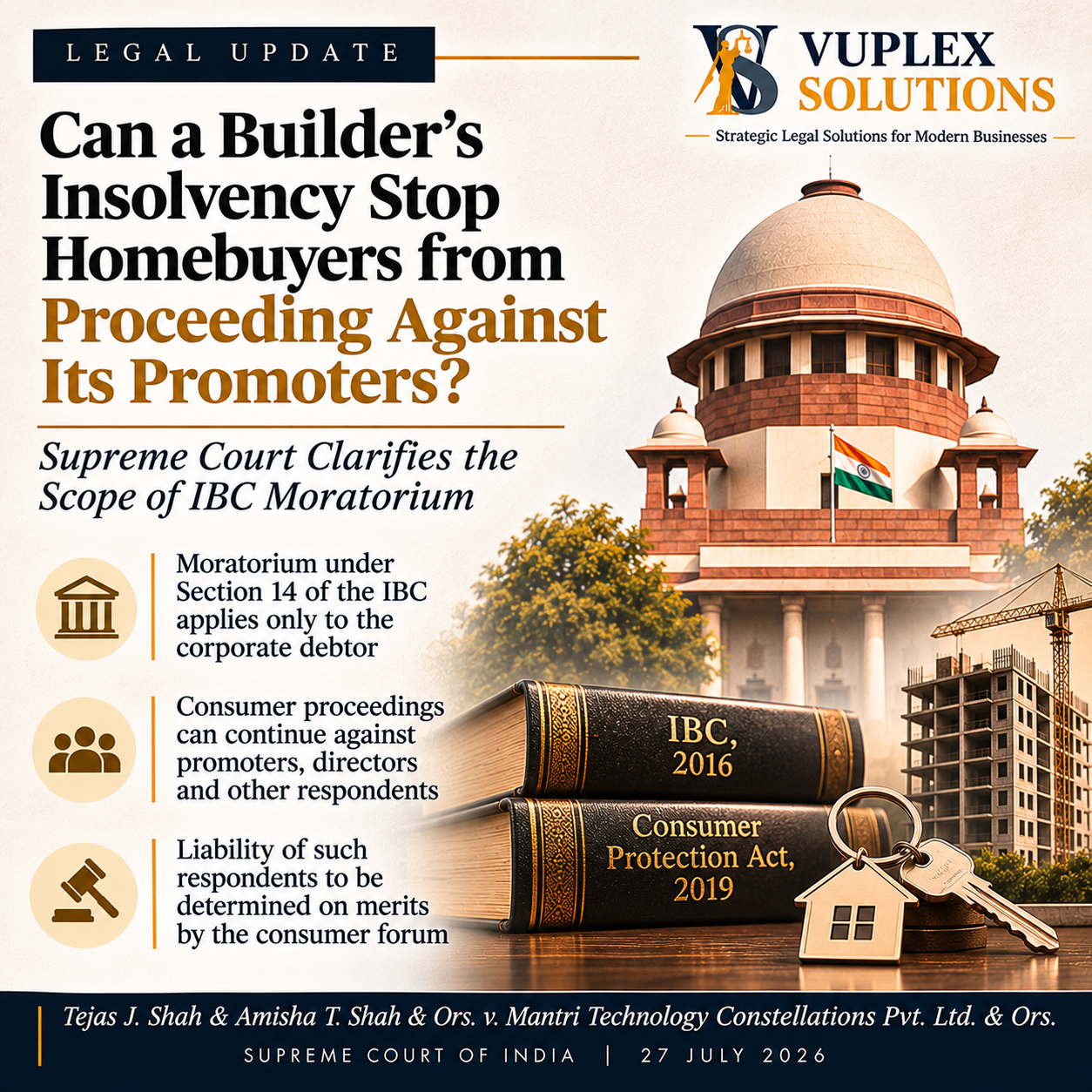
Can a Builder’s Insolvency Stop Homebuyers from Proceeding Against Promoters?
In Tejas J. Shah v. Mantri Technology Constellations Pvt. Ltd. (2026 INSC 746), the Supreme Court holds that the Section 14 IBC moratorium applies solely to the corporate debtor and does not shield promoters or directors from consumer claims.