IBC Cannot Be Invoked as a Recovery Tool Where Loan Structure Is Performance-Linked: Supreme Court
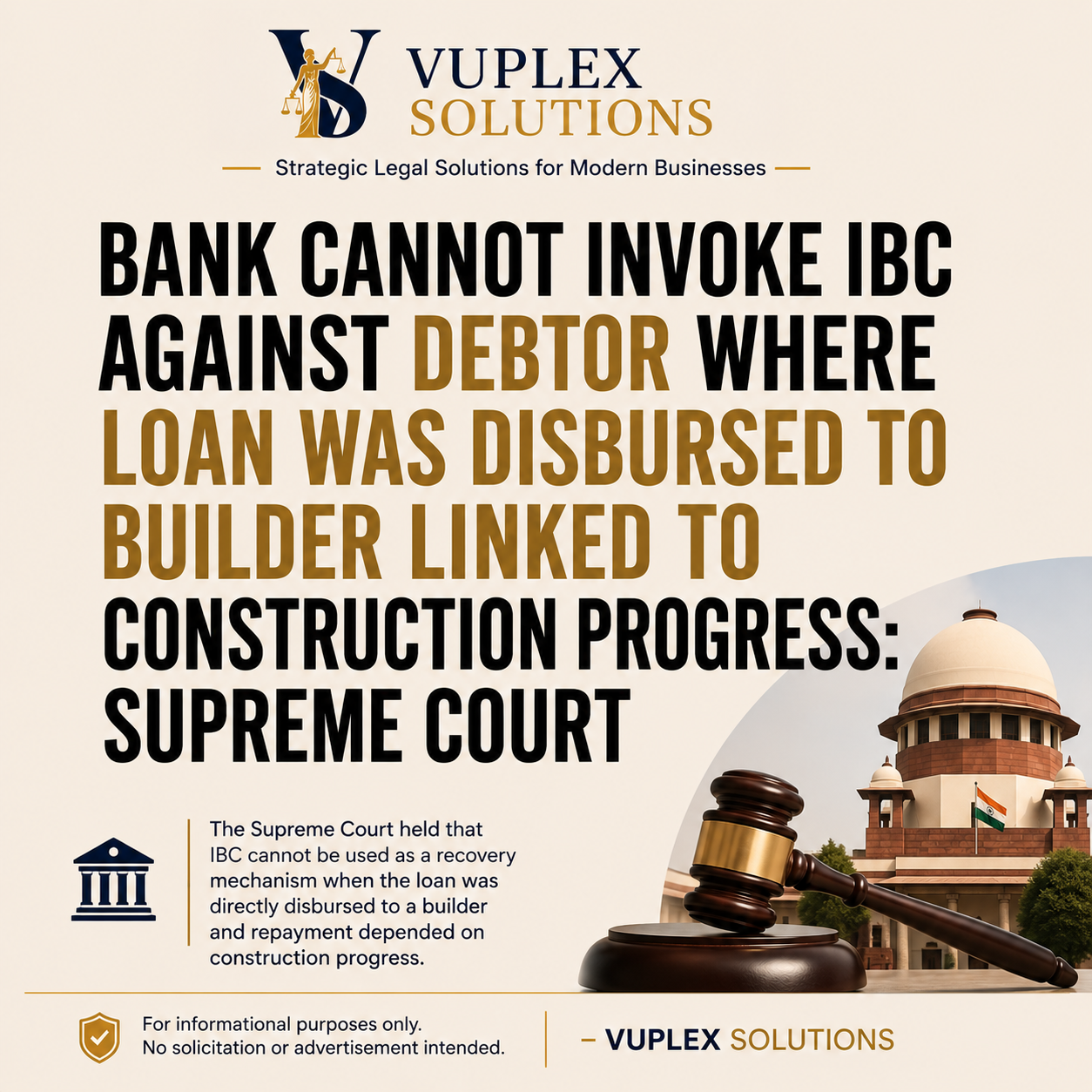
The Supreme Court has clarified the limits of the Insolvency and Bankruptcy Code, 2016 (IBC), reiterating that insolvency proceedings cannot be used as a substitute for debt recovery, particularly where the underlying transaction is not a straightforward financial debt arrangement.
Factual Matrix
The dispute arose from a financing arrangement in which a bank disbursed approximately rupees 1.34 crore directly to a builder for the purchase of a property by the corporate debtor. The disbursement was not made into the account of the corporate debtor but was linked to the progress and obligations of the builder under a structured arrangement.
Subsequently:
- The corporate debtor's account was classified as a Non-Performing Asset (NPA).
- Recovery proceedings were initiated before the Debt Recovery Tribunal (DRT).
- Parallelly, winding-up proceedings were initiated and later treated as proceedings under Section 7 of the Insolvency and Bankruptcy Code, 2016.
- The National Company Law Tribunal (NCLT) admitted the Corporate Insolvency Resolution Process (CIRP).
- The National Company Law Appellate Tribunal (NCLAT) set aside the admission.
The matter then reached the Supreme Court.
Issue for Consideration
Whether insolvency proceedings under Section 7 IBC can be initiated where:
- The loan amount was not directly disbursed to the corporate debtor; and
- The transaction structure involved third-party obligations, particularly performance-linked construction obligations of a builder.
Supreme Court's Analysis
The Court examined the structure of the transaction rather than merely its form. It noted that:
- The disbursement was directly made to the builder.
- The arrangement was governed by a quadripartite understanding involving obligations beyond a simple lender-borrower relationship.
- Repayment obligations were intrinsically connected to the builder's performance in completing construction and transferring the property.
On this basis, the Court held that such a transaction cannot be treated as a pure financial debt simpliciter within the meaning of Section 5(8) of the IBC without examining the surrounding contractual framework.
Key Findings
IBC Is Not a Recovery Mechanism: The Court reaffirmed that the IBC is intended for resolution of genuine insolvency and not for enforcing recovery of dues. Invocation of CIRP solely to compel repayment is impermissible.
Substance Over Form: Where the transaction involves layered obligations and third-party performance dependencies, it cannot be isolated as a standard financial creditor-debtor relationship.
Contractual Disputes Fall Outside IBC Framework: Disputes arising from performance of contractual obligations such as construction-linked disbursement are not suitable for insolvency adjudication.
Abuse of Process Standard: If the objective behind invoking the Code is coercive recovery rather than insolvency resolution, such initiation would amount to abuse of the statutory process.
Decision
The Supreme Court upheld the decision of the NCLAT and dismissed the bank's appeal, thereby rejecting the initiation of CIRP against the corporate debtor.
Legal Position Emerging
This judgment reinforces a consistent line of jurisprudence:
- IBC proceedings require a clear financial debt and default, not a complex contractual dispute.
- Direct disbursement to third parties, coupled with performance-linked obligations, weakens the classification of the transaction as a straightforward financial debt.
- Parallel recovery mechanisms (DRT, civil remedies) remain the appropriate forum in such cases.
Implications for Banking and Real Estate Transactions
- Banks must exercise caution in structuring disbursements directly to builders.
- Documentation must clearly establish debtor liability independent of third-party performance.
- Insolvency proceedings cannot be used strategically where contractual enforcement is the real dispute.
More Insights

Legal Due Diligence in Real Estate Transactions in Bangalore
Bangalore's real estate sector is governed by a layered framework of central and state legislations. A comprehensive guide to title verification, RERA compliance, encumbrance checks, and the essential documents every buyer must examine before acquisition.

Legal Scrutiny Report (LSR) in Banking: Nature, Scope, and Legal Position
In secured lending transactions involving immovable property, banks rely on a Legal Scrutiny Report to verify title, marketability, and enforceability of the security. An analysis of the statutory framework and the advocate's role in the LSR process.

Can Law Students Be Barred From Exams Over Attendance Shortage? Supreme Court Set To Decide
The Supreme Court has agreed to examine the Delhi High Court's 2025 ruling that law students should not be detained from examinations merely for attendance shortage. A look at the competing considerations of academic discipline and proportionality.