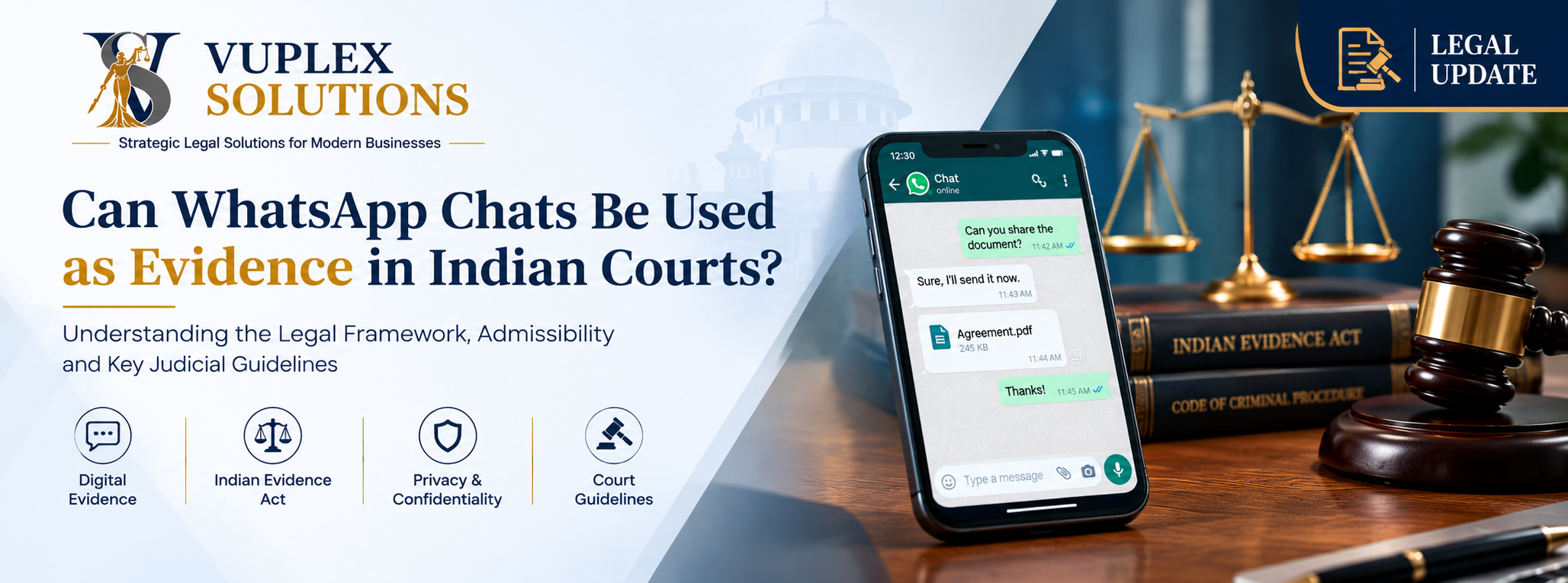
Understanding the Legal Framework, Admissibility and Requirements for Digital Evidence
WhatsApp has become an integral part of everyday communication in India. From business negotiations and employment discussions to family conversations, financial transactions and legal notices, important information is increasingly exchanged through messaging platforms.
But an important legal question arises: Can a WhatsApp chat actually be used as evidence in an Indian court?
The short answer is yes. However, simply taking a screenshot of a conversation does not automatically make it admissible evidence.
With the Bharatiya Sakshya Adhiniyam, 2023 (BSA) now governing the law of evidence, electronic records—including WhatsApp messages—are subject to specific requirements for proving their contents. The BSA came into force on 1 July 2024.
WhatsApp Chats as Electronic Evidence
A WhatsApp conversation is essentially an electronic record.
Section 61 of the Bharatiya Sakshya Adhiniyam provides that an electronic or digital record cannot be denied legal effect merely because it is electronic. However, its admissibility is subject to the requirements prescribed under the Act, particularly Section 63.
Therefore, a WhatsApp message can potentially be relevant evidence in matters such as:
- Business and commercial disputes
- Contractual disputes
- Employment disputes
- Matrimonial and family matters
- Criminal proceedings
- Financial transactions
- Consumer disputes
- Defamation matters
- Negotiations and communications between parties
But relevance alone is not enough.
What Does Section 63 of the BSA Say?
Under the new evidence law, Section 63 of the Bharatiya Sakshya Adhiniyam, 2023 deals with the admissibility of electronic records.
It broadly carries forward the role previously played by Section 65B of the Indian Evidence Act, 1872, which governed the proof of electronic evidence.
The important point is that electronic evidence produced in the form of a computer output must satisfy the statutory requirements.
The BSA also provides a specific certificate format in its Schedule. The certificate includes information concerning the device or digital source, its lawful control, the manner in which the record was produced, and the functioning of the device. It also provides for recording the hash value of the electronic record.
Is a Screenshot of WhatsApp Enough?
Not necessarily.
This is one of the biggest misconceptions about WhatsApp evidence.
A screenshot can show what appears to be a conversation, but questions may arise regarding:
- Who actually sent the messages?
- Whether the screenshot has been edited.
- Whether messages were deleted or omitted.
- Whether the account belonged to the alleged person.
- Whether the device was functioning properly.
- Whether the electronic record has been preserved correctly.
Therefore, parties seeking to rely on WhatsApp conversations should preserve the original electronic record and relevant device/data, rather than relying exclusively on screenshots.
The Importance of the Section 63 Certificate
The certificate is particularly important where electronic evidence is being produced as a computer output or other form covered by Section 63.
The Supreme Court's jurisprudence under the earlier Section 65B continues to be important in understanding the principles behind electronic evidence. In Arjun Panditrao Khotkar v. Kailash Kushanrao Gorantyal, the Supreme Court reaffirmed that the statutory certificate requirement for secondary electronic evidence was a condition precedent to admissibility. The Supreme Court has subsequently referred to Section 63 of the BSA as the corresponding provision under the new law.
This makes one thing clear: Digital evidence should not be treated casually merely because it can be captured on a smartphone.
What Information Should Be Preserved?
If a WhatsApp conversation may become relevant to a legal dispute, it is advisable to preserve more than just selected screenshots. Depending on the circumstances, relevant material may include:
- Complete conversation history: Preserve the relevant conversation rather than selectively presenting isolated messages.
- Original device: Keep the phone or device containing the conversation safely preserved.
- Media and attachments: Photographs, videos, documents, voice notes and other files may also be relevant.
- Dates and timestamps: Preserve the context showing when messages were sent and received.
- Exported chat data: Where appropriate, an exported conversation may assist in presenting the communication in a structured form.
- Metadata and technical information: Where authenticity is disputed, technical examination may become important.
- Section 63 certificate: Where required, the appropriate statutory certificate should accompany the electronic evidence.
Can WhatsApp Chats Prove a Contract?
Potentially, yes.
Suppose two businesses negotiate a commercial arrangement through WhatsApp and one party later denies that an agreement was reached. The conversation may become relevant evidence regarding:
- Negotiation
- Offer and acceptance
- Commercial terms
- Payment discussions
- Delivery commitments
- Representations made by the parties
However, the court will examine the entire evidentiary context. A WhatsApp conversation does not automatically establish every legal element of a contract merely because the messages exist. The authenticity, context, completeness and surrounding evidence can all matter.
WhatsApp Evidence in Criminal Cases
WhatsApp conversations can also become relevant in criminal investigations and trials.
For example, chats may potentially be relied upon to establish communications between individuals, transactions, planning, threats, admissions or other relevant facts. But criminal courts apply strict standards when determining whether evidence is admissible and what weight it deserves.
A message appearing on a phone is therefore not automatically proof of guilt. The prosecution still has to establish the relevant facts in accordance with law.
What If the Other Person Has the Phone?
This can create a practical problem.
A party may know that important WhatsApp messages exist but may not have access to the device containing them.
The Supreme Court's electronic-evidence jurisprudence has recognised this practical difficulty and explained the procedural route for obtaining necessary electronic evidence when the relevant device or system is under someone else's control.
In appropriate circumstances, the court can be approached for directions concerning production of the relevant electronic evidence.
Privacy Is Also Important
There is another side to the issue: privacy.
Just because a person has access to a WhatsApp conversation does not mean that every private conversation can be freely circulated or published.
Legal proceedings involve questions concerning privacy, confidentiality and the relevance of the material being produced. Therefore, parties should avoid unnecessarily sharing private conversations outside the legal process and should obtain appropriate legal advice before using sensitive communications in litigation.
A New Digital-Evidence Reality for Businesses
For businesses, the increasing importance of WhatsApp creates both opportunities and risks.
Employees and business owners routinely use WhatsApp for customer communication, vendor negotiations, purchase orders, payment discussions, contract negotiations, internal instructions, project approvals, and business commitments.
Companies should therefore consider having proper policies for preserving important digital communications. A casual WhatsApp message can sometimes become relevant years later in a commercial dispute.
Key Takeaways
- WhatsApp chats can be evidence: Indian courts can consider WhatsApp conversations as electronic records when the legal requirements are satisfied.
- A screenshot is not automatically sufficient: The authenticity and manner of proving the electronic record can be crucial.
- Section 63 of the BSA is important: The Bharatiya Sakshya Adhiniyam, 2023 now governs electronic evidence and replaced the Indian Evidence Act from 1 July 2024.
- Preserve the original evidence: Where possible, preserve the original device, complete conversation, attachments and other relevant digital information.
- Certification matters: The statutory certificate under Section 63 can be critical when electronic evidence is produced in the form covered by the provision.
- Context matters: Even admissible WhatsApp evidence must still be evaluated for authenticity, relevance and evidentiary weight.
Download Full Report
Get complete access to the detailed analysis on digital evidence in Indian courts.
Download Document (.docx)Conclusion
WhatsApp has transformed how Indians communicate, and the law of evidence has had to evolve alongside this digital reality.
Yes, WhatsApp chats can be used as evidence in Indian courts—but the way those chats are preserved, authenticated and presented can be just as important as the content of the messages themselves.
For individuals and businesses involved in litigation, simply taking screenshots may not be enough. Proper preservation of digital evidence and compliance with the Bharatiya Sakshya Adhiniyam, 2023 can significantly strengthen the evidentiary foundation of a case.
As digital communication continues to become a central part of commercial and personal life, understanding the rules surrounding electronic evidence is no longer optional—it is an important part of modern legal awareness.
More Insights

Legal Due Diligence in Real Estate Transactions in Bangalore
Bangalore's real estate sector is governed by a layered framework of central and state legislations. A comprehensive guide to title verification, RERA compliance, encumbrance checks, and the essential documents every buyer must examine before acquisition.

Allahabad High Court on Hookah Bars: Public Health and Commercial Limits
The Allahabad High Court has delivered an important judgment holding that hookah services cannot be provided even within a designated smoking area, emphasizing public health over commercial interests.
Advocate–Client Confidentiality Does Not End When the Case Ends: Supreme Court Reinforces Professional Duties
What the Supreme Court’s latest ruling means for lawyers, clients and the handling of confidential information.